
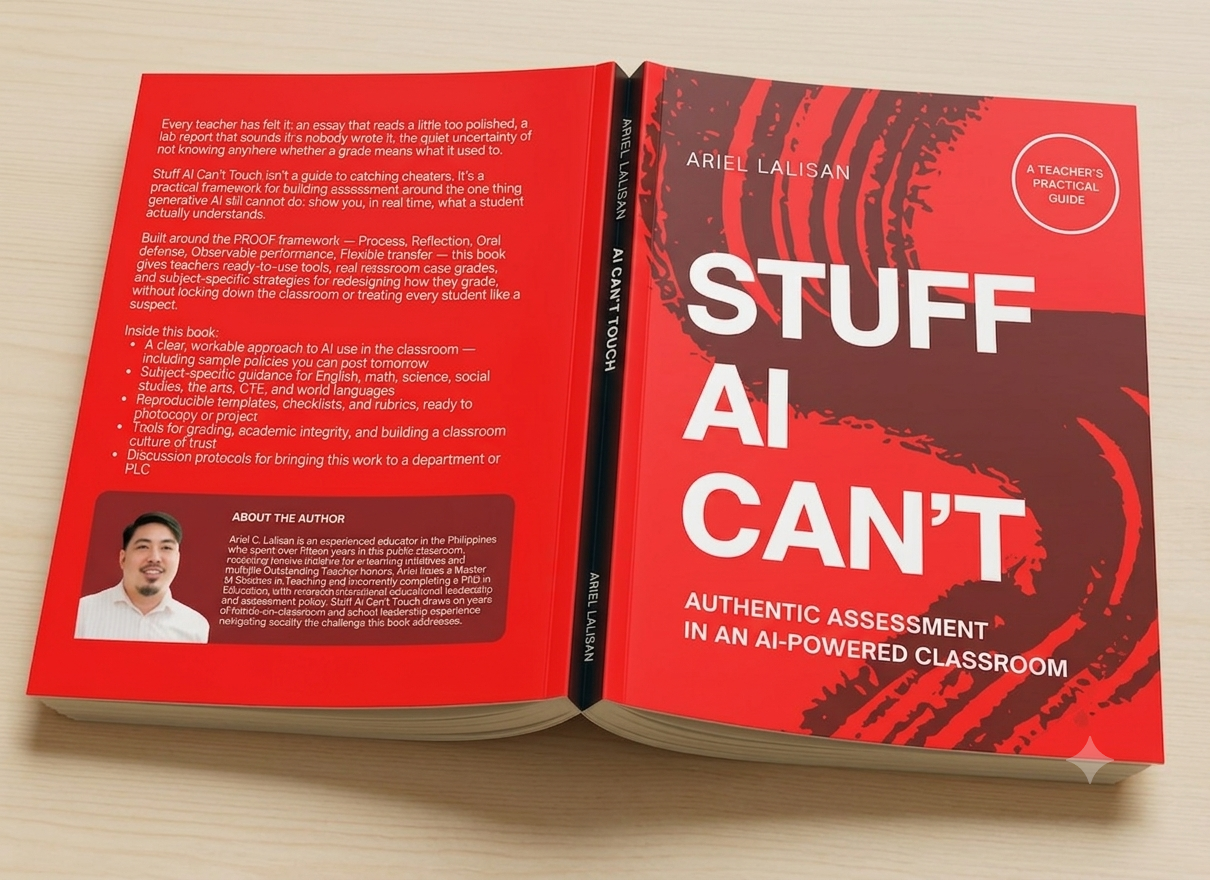
Your students have AI. Here’s how to grade what it still can’t do.
A ninth-grade research paper comes back with a rubric score higher than the student has ever earned before. The teacher asks one follow-up question — “Tell me about the source you found hardest to use” — and half the class goes blank.
That gap is the problem this book solves.
Stuff AI Can’t Touch isn’t a guide to catching cheaters or locking down your classroom with detection software and browser restrictions. It’s a practical, teacher-tested approach to building assessments around the one thing generative AI still cannot do: demonstrate a student’s own understanding, live, under real conditions.
Built around the PROOF framework — Process, Reflection, Oral defense, Observable performance, Flexible transfer — this book gives you a complete, ready-to-use system for redesigning how you assess student learning in the age of AI.
Inside, you’ll find:
- A clear, non-paranoid way to think about AI use in your classroom — including sample AI-use policies you can post tomorrow
- Subject-specific strategies for English, math, science, social studies, the arts, CTE, and world languages
- Real classroom case studies showing what these redesigns look like in practice
- Reproducible templates, checklists, and rubrics you can photocopy or project directly
- Guidance on grading, academic integrity, and building a classroom culture of trust instead of suspicion
- PLC and department discussion protocols for rolling this out school-wide, not just in one classroom
Whether you’re one teacher trying to restore confidence in your grades or a department head leading a school-wide rethink, this book gives you a concrete starting point — not a theory, a Monday-morning plan.
AI changed what a finished product can prove. It hasn’t changed what a real conversation, a live performance, or an honest reflection can prove. This book shows you how to grade that instead.
Leave a Reply